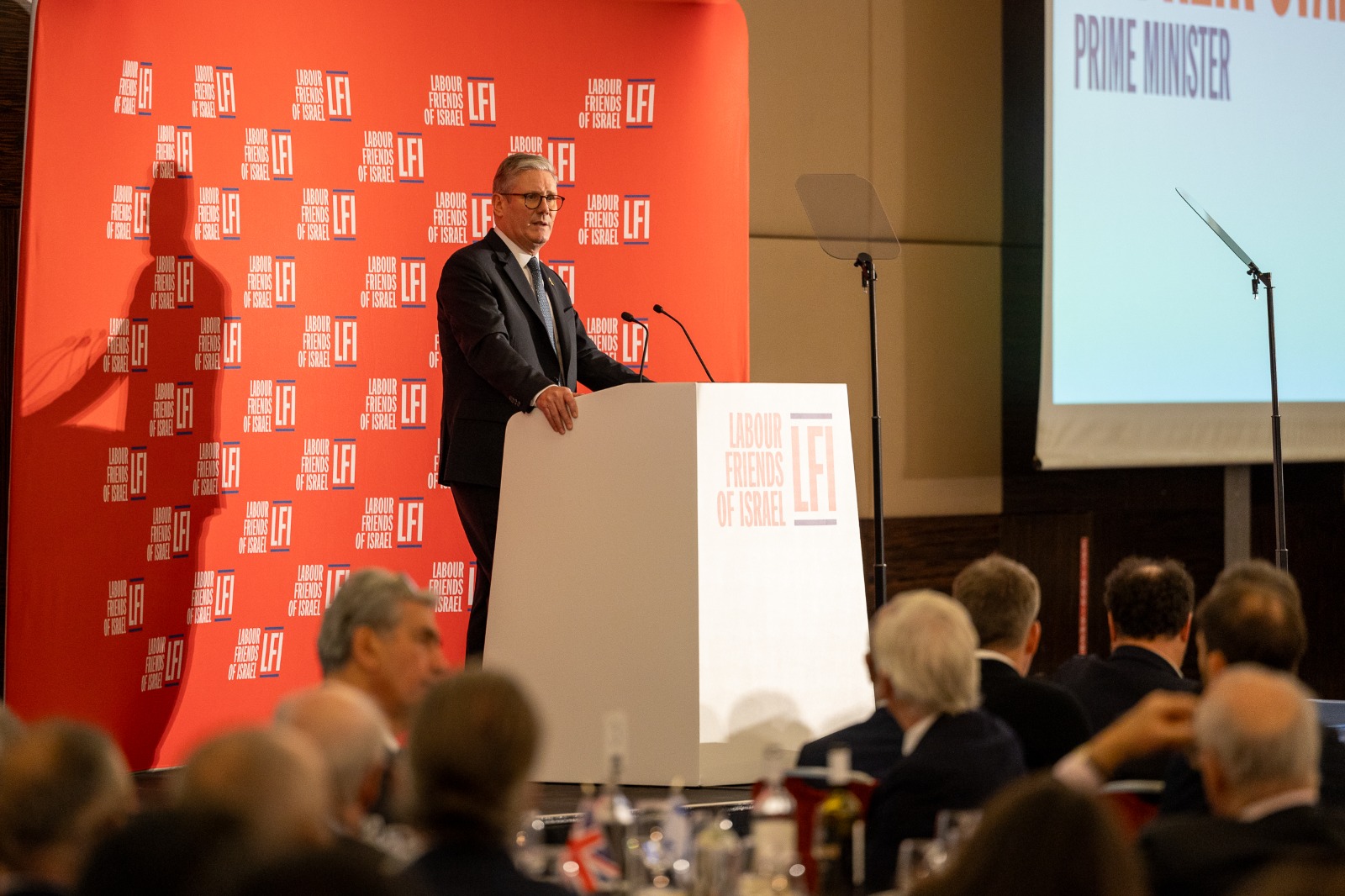
LFI thanks Keir Starmer for his leadership in the fight against antisemitism
As Keir Starmer noted yesterday morning, he inherited a Labour party which was “politically, financially and morally bankrupt”.
Nothing illustrates the depth of that challenge more starkly than the period under his predecessor, during which antisemitism was allowed to take root and spread within the party.
From day one, Keir has taken a determined and principled approach to addressing antisemitism, working to rebuild trust and ensure that those who espoused racism or apologists for it have no place in the Labour party.
He has also demonstrated strong support for the State of Israel in the aftermath of the 7 October pogrom. His commitment to a two-state solution has been reflected in Britain’s leading role in establishing the new International Fund for Israeli-Palestinian Peace. Domestically, his government is acting to confront antisemitism in the public sector, significantly increasing funding for the Jewish community’s security, recognising the threat posed by extremism, and delivering on his commitment to proscribe Tehran’s terror army, the Islamic Revolutionary Guard Corps.
This is a record of which he can be proud, and one which reflects a serious commitment to principle and responsibility.
LFI is proud to have supported the prime minister. We thank him for his leadership and service in changing the Labour party and the country for the better, and wish him well for the future.
This week we’re covering US-Iran negotiations, continued fighting in Lebanon and foiled terror in the West Bank.
Top stories
Israel-Iran negotiations
- Following direct negotiations, the US and Iran have agreed a roadmap for further talks over the next 60 days focused on outstanding issues such as the threat from Iran’s nuclear programme and the Strait of Hormuz. The Strait had been reopened last week, only for the Islamic Revolutionary Guard Corps to close it again following continued fighting in Lebanon between Israel and Iran-backed Hezbollah.
Lebanon
- The memorandum of understanding agreed by Iran and the US is also covers fighting in Lebanon between Israel and Iran-backed Hezbollah. Israel has not been a party to the negotiations. Hezbollah has continued to attack Israeli positions in the south of Lebanon and Israel has continued to strike Hezbollah infrastructure in return.
- An IDF soldier was killed and 13 others wounded in southern Lebanon during an attack by Hezbollah. Sgt. First Class Nir Ben Ari was killed amid operations to capture a major underground Hezbollah facility beneath the Ali Taher ridge. Following the deadly attack, the IDF carried out strikes on Hezbollah infrastructure in the Nabatieh area.
Terror in Israel
- The Shin Bet, Israel’s domestic security agency, has announced that it foiled dozens of planned terror attacks in the West Bank directed by Hamas operatives in Turkey in the past year. The Shin Bet named several Turkey-based operatives in Hamas’ so-called West Bank Headquarters, a unit in the terror group responsible for advancing attacks against Israel from or within the West Bank.

In Depth: US and Iran agree roadmap for further peace talks
The US and Iran held direct negotiations over the weekend, agreeing a “roadmap” toward reaching a final deal to end the war within 60 days. Mediators Pakistan and Qatar are reporting “encouraging progress”. JD Vance, the US vice-president, claimed that Iran had agreed to let International Atomic Energy Agency inspectors back into the country from as early as this week. Iran has denied Vance’s claim.
Last week, Washington and Tehan agreed a 14-point memorandum of understanding, which resulted in the reopening of the Strait of Hormuz.
Talks are expected to continue throughout the week in Switzerland. Based on the memorandum, negotiators have developed a high-level committee, which will provide political oversight on the mediation as well as working groups focused on nuclear issues, sanctions and a monitoring and dispute resolution group. The talks also included a “de-confliction cell”, between the parties and Lebanon focused on the continuing conflict between Hezbollah and Israel, resulting from the terror group’s attacks on northern Israel.
The continued fighting between Hezbollah and Israel in Lebanon threatened to scupper the talks, leading Iran to close the Strait of Hormuz again only days after it was declared open to international shipping. Iran also said that it would not discuss substantive issues such as its nuclear programme until the fighting in Lebanon ends and it is reported to have walked out of negotiations with the US at one stage over the weekend.
The memorandum included a provision to end fighting in Lebanon between Israel and Hezbollah. Despite this, four soldiers were killed in a Hezbollah attack on a tank in southern Lebanon early Friday morning amid operations to capture a Hezbollah terror facility beneath Ali Taher ridge. The IDF has assessed that Hezbollah has a major “strategic” underground facility beneath the ridge, which is located near Nabatieh. According to the military, dozens of Hezbollah operatives remain holed up underground in the area, and fighting has taken place above and below ground in recent days.
In violation of a ceasefire agreed earlier in June, Hezbollah launched more than 175 projectiles at Israeli troops in southern Lebanon on Saturday. Israel’s leadership has said that it would not withdraw from positions in southern Lebanon until Hezbollah no longer represents a threat to Israel, particularly residents in the north who have, once again, been attacked by missiles and drones for several months. Israel has established a buffer zone that currently runs up to 10 km (6 miles) deep from the border into Lebanese territory. Israel’s military is pressing the country’s leadership to speed up negotiations with the Lebanese government, which began weeks ago to end the fighting in Lebanon. It is hoping to achieve two aims: preserving the buffer zone in the south and destroying the major underground Hezbollah facility. US-mediated talks between Israel and Lebanon are expected to resume this week.
Since its publication late last week, the US-Iran memorandum has been met with grave concerns in the Jewish state, with 92 per cent of Israelis believing Iran has won the war. It commits Iran to reopening the Strait of Hormuz to international shipping and the US to lifting its blockade on Iranian ports. The strait will reopen without tolls for two months but the levying of fees in the future is not precluded. Washington has committed to immediately lifting oil sanctions on Iran’s economy.
But the memorandum does not offer reassurance on a number of longstanding issues:
- There is also no mention of Iran’s domestic repression, which has accelerated since the regime crushed protests in January with widespread massacres in which 30,000 people are reported to have been killed.
- Iran’s nuclear programme is a key element for discussion for ongoing negotiations. The memorandum commits Iran to “down-blend” Iran’s existing stockpile of 440kg of enriched uranium. However, this does not resolve the issue of Iran maintaining the capacity to accelerate its nuclear programme clandestinely, which it has done in the past.
- The agreement does not, and further negotiations will not, address Iran’s support for proxies like Hezbollah and Hamas and may result in increasing funding for these groups. Following Iran’s infusion of a reported $1bn into Hezbollah last year, there is already speculation that Iran has made such commitments to the terror group.
- There is no reference to Iran’s ballistic weapons – many hundreds of which were launched at Israel and other countries in the region over the course of the war.
Latest from LFI
LFI board member argues debate over pro-Israel influence sends a “dreadful message”
In a piece for Jewish News, LFI board member Dame Louise Ellman argues a debate being held this week in parliament as a result of a petition calling for a public inquiry into “pro-Israel influence” is “nothing short of an opportunity for centuries-old antisemitic tropes about Jews, money and power to be peddled and propagated in the mother of parliaments”.
LFI honorary parliamentary chair praises Starmer for talking antisemitism
In an interview with the Jewish Chronicle, Mark Sewards MP said Keir Starmer deserves huge credit for tackling antisemitism within Labour – without which the party would not have won the 2024 general election. The MP for Leeds South West and Morley discussed the challenges of being a pro-Israel voice in parliament, his fears about the rise of the Green party, and his longstanding affinity for, and connections with, Leeds University’s Jewish Society.
Mark Sewards calls for swift IRGC designation in “state threats” bill debate
Honorary parliamentary chair of LFI, Mark Sewards MP, spoke during last week’s national security (state threats) bill debate, where he made the case for proscribing the IRGC and welcomed the government’s new legislation which will allow it to do so.
LFI publishes its latest paper: Partners in Crime: The Tehran-Moscow Axis of Aggression
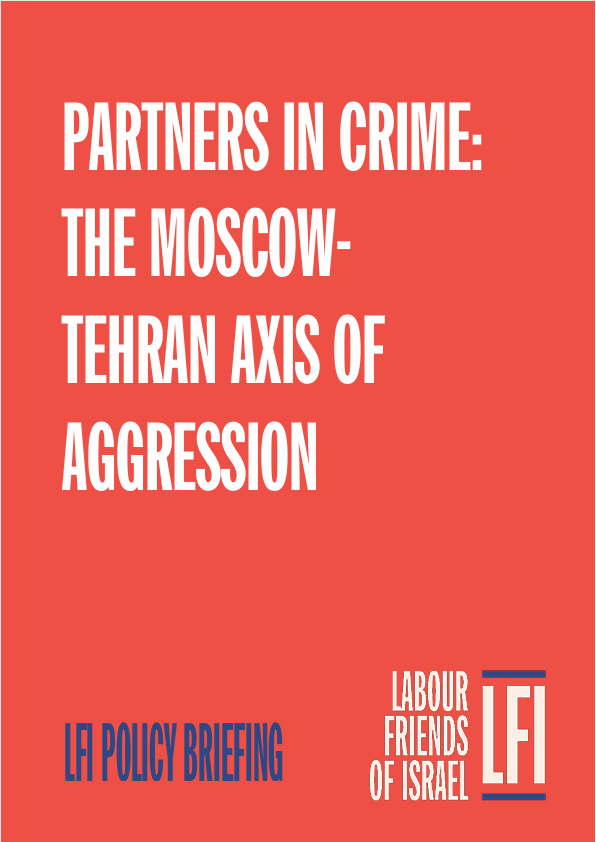
LFI’s new paper argues that while there is no doubt that the government has recognised the Iranian threat – including through taking forward new powers to proscribe the Islamic Revolutionary Guards Corps – the same systematic approach which the UK has taken to address the Russian threat has not yet been applied to Iran.
To counter this dual threat, improve our resilience and demonstrate our resolve, the paper’s author, Dr Matthew Godwin, LFI’s director policy and research, says the UK government should:
- Adopt the same, comprehensive sanctions regime against Iran as it has toward Russia, working closely with allies to mirror sanctions against the depth and breadth of Iran’s political, military and economic sectors.
- Identify and dismantle the soft influence networks in the UK which Tehran uses to advance its objectives under the cover of cultural, academic, charitable and media activity. Specifically, as it has with Russia, the UK should sanction all of Iran’s propaganda platforms and close down all opportunities for the Islamic Republic to continue its information warfare against the UK. It should further end Iran’s malign network in the charitable sector and carry out a China-style review to uncover the extent of its web of influence.
- To demonstrate our firm resolve against the regime’s threats, the UK should, as it has with Russia, use every opportunity to isolate Iran through international institutions and bilateral diplomacy. This should include expelling Iran’s ambassador and other diplomats, as well as the supreme leader’s representative in the UK.
In a foreword for the paper – covered in the Daily Telegraph – David Taylor MP argues: “The Moscow-Tehran axis helped sustain the murderous regime of Bashar al-Assad in Syria. It is responsible for the deaths of tens of thousands of men, women and children in Ukraine. And, as the defence secretary, John Healey, has rightly warned, Russia’s “hidden hand” lies behind Iran’s military methods in the conflict between Israel, the US and Iran this spring. Moscow has supplied Tehran with crucial intelligence and targeting information, drones and diplomatic support.”
Taylor continues: “Like Russia, Iran has sought – and succeeded – in bringing terror to the streets of our country; it seeks to recruit operatives on our shores; and it has attempted to meddle in our democratic process while launching cyberattacks and waves of dangerous and divisive disinformation. Moreover, as we have graphically seen in recent weeks, Iran has deployed proxies in the UK to target British Jews, leading to the appalling upsurge in antisemitic attacks to which the community has been subjected.”
Across all mainstream polls, Yashar, a centre-left party led by former IDF chief Gadi Eisenkot, is now the largest opposition party. In some surveys earlier this month, the party was first shown overtaking the next-largest party, Beyachad — a centrist alliance established by former prime ministers and past coalition partners Yair Lapid and Naftali Bennett.
Channel 12’s latest polling reads as follows: 22 seats Likud, 21 seats Yashar, 19 seats Beyachad, 10 seats Democrats, 9 seats Shas, 9 seats Yisrael Beiteinu, 9 seats Otzma Yehudit, 7 seats United Torah Judaism, 5 seats Hadash-Ta’al, 5 seats Ra’am, 4 seats Religious Zionism.
In total, the Zionist opposition commands 59 seats, the Arab-led parties control 10, and the governing coalition holds 51.
Another survey released late last week by Maariv paints a more favourable picture for the opposition, showing the anti-Netanyahu bloc breaking the 61-seat threshold for forming a new government as the coalition sinks to 49 seats.
While movement between blocs remains limited at this stage, shifts are underway in Netanyahu’s camp. Both surveys highlight dwindling support for Likud, predicting a decline of 10 or more seats from the party’s current standing in parliament. While its backing has fluctuated over the past two and a half years, Likud has experienced a steep drop in popularity since the outbreak of war with Iran on 28 February. At the party’s nadir, in the weeks after 7 October, Likud was projected to earn 19 seats — meaning its current position is only modestly stronger.
Betzalel Smotrich’s Religious Zionism crossed the electoral threshold for entering the Knesset in the two surveys, reflecting a consistent pattern over the past few months. However, the risks of the party falling short of the electoral threshold have spurred calls for a merger between Religious Zionism and Itamar Ben Gvir’s Otzma Yehudit. Ben Gvir has dismissed the possibility of a merger, placing Religious Zionism at greater risk of failing to enter the Knesset. In such an event, tens of thousands of votes for the party would go to waste, stripping the coalition of an important reservoir of support and possibly helping propel the opposition to a governing majority.
Image: 3-Arman anti-ballistic missile system, Hossein Zohrevand, CC BY-SA 4.0, via wikimedia commons.